

Most asphalt roofs do not fail because of one dramatic event. They fail because of three small things nobody looked at for six years. A missing granule patch here, a cracked sealant line there, a gutter that has been overflowing onto the same fascia board since the spring.
I spent nine years on residential roofing crews before moving into inspection work, and the pattern holds almost every time. The roofs that reach twenty five years are rarely the expensive ones. They are the ones that got a two hour inspection every autumn and a five pound tube of sealant every couple of years.
This piece covers the essential asphalt roof maintenance steps that genuinely extend shingle life, the ones that are a waste of a weekend, the seasonal timing that matters, the repairs worth doing yourself, and the warning signs that mean you should stop climbing and call someone.
Why Asphalt Shingles Fail in the First Place
Asphalt shingles are a layered product. A fibreglass mat sits in the middle, coated with asphalt, then topped with mineral granules that protect the asphalt from sunlight. The granules are the sacrificial layer, and everything about shingle lifespan comes back to how long they last.
Sun breaks down the asphalt over time. When the granules wear away, the asphalt underneath gets exposed directly to ultraviolet light and starts to dry, crack, and lose its flexibility. Once the shingle cannot flex, it cannot seal, and once it cannot seal, water gets underneath.
That progression is slow and it is visible years before it becomes a leak. That is the whole reason essential asphalt roof maintenance works. You are not preventing ageing. You are slowing the process at the points where it accelerates.
The Granule Story
Granules come off from the day a roof is installed. New roofs shed heavily for the first year, which is normal, and the rate settles afterwards.
What matters is where they are missing. Even granule loss across the whole roof is ageing. Concentrated loss in patches, especially on south facing slopes, usually indicates something specific. Hail impact, a manufacturing defect, or foot traffic from repeated repairs.
Check the gutters at the end of summer. A handful of granules is normal. A visible layer of grit across the bottom of the gutter, year after year, tells you the shingles are shedding faster than they should.
The Attic Connection
Shingle life is decided partly from underneath, and almost nobody checks.
A roof that vents poorly cooks itself from the inside. Attic temperatures in an under vented roof can reach levels that accelerate asphalt degradation substantially, and the moisture trapped inside does its own damage to the decking below.
Proper intake and exhaust ventilation is not an optional extra for comfort. It is a lifespan decision. If your attic is hot enough to be uncomfortable in July, your shingles are ageing faster than they should.
The Essential Asphalt Roof Maintenance Steps
There are six steps worth doing, and they are not equal in value. Two of them prevent most of the damage, and the rest are catching problems early.
Step One: Clear the Debris Twice a Year
Debris holds moisture against the roof surface and blocks the drainage paths that carry water away. Leaves, twigs, and moss all do the same job badly.
Clear gutters and downpipes in late autumn after leaf fall and again in early spring. Clear the roof surface of anything that has accumulated in valleys and behind chimneys, where debris collects fastest because the geometry funnels it there.
Do not use a pressure washer on asphalt shingles. The pressure strips granules and drives water under the edges, and a single aggressive pass can remove years of protective surface. A soft brush or a leaf blower on low is what you want.
Step Two: Inspect the Sealant Lines and Flashing
This is the step that saves the most money, and it is the one most homeowners skip because it requires getting close.
Every penetration through the roof has flashing. Chimneys, vents, skylights, satellite mounts, and soil stacks all create a joint where the roof meets something that is not roof. Sealant around those joints degrades faster than anything else on the roof, because it moves with temperature and takes direct water.
Check every flashing line twice a year and reseal any crack you can fit a fingernail into. Sealant is inexpensive and the repair takes minutes. Water getting behind failed flashing rots decking and framing, and that repair is measured in thousands.
Step Three: Check and Replace Damaged Shingles
Individual damaged shingles are common after wind and hail, and replacing one is straightforward if you catch it before the damage spreads.
Look for shingles that are curled at the edges, cracked across the face, missing tabs, or lifted at the seal strip. A lifted shingle invites wind under the next one, so a single failure cascades.
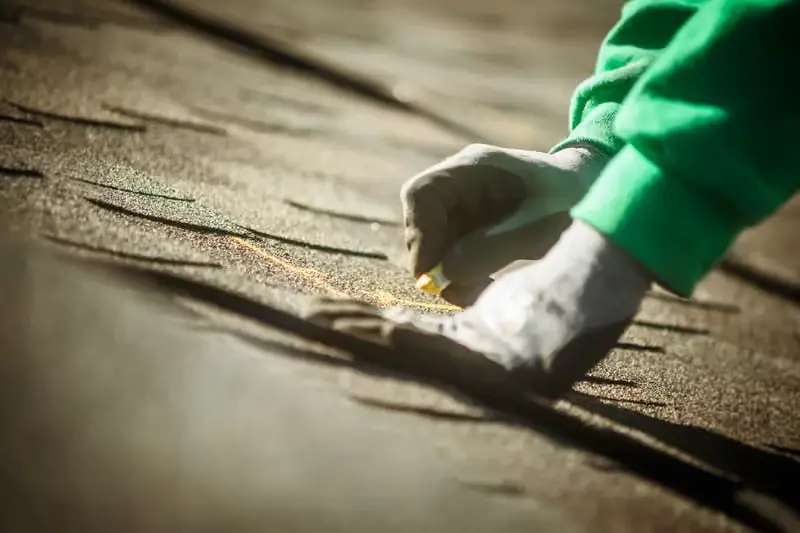
Replacement means lifting the tabs above, removing the damaged shingle, sliding a new one in, and sealing it with roofing cement. It takes twenty minutes and it prevents a much larger repair. If the damage is scattered across a whole slope rather than isolated, patching is not the answer and replacement becomes the conversation.
Step Four: Deal With Moss and Algae Properly
Moss and algae are separate problems with separate treatments, and confusing them wastes effort.
Algae appears as dark streaks running down a slope. It is cosmetic in most cases and it does not damage the shingle, though it looks like it should. Moss is different. It holds moisture against the surface, lifts shingle edges as it grows, and eventually gets roots under the tabs.
Remove moss gently with a soft brush, never by scraping or pressure washing. Then treat the area with a moss control product and address the cause, which is usually shade and trapped moisture. Zinc or copper strips along the ridge line are a well established way to prevent recurrence, because rain washing over the metal creates an environment where moss will not grow.
Step Five: Trim Overhanging Branches
Branches do four separate kinds of damage and all of them are avoidable.
They drop debris that traps moisture. They shade the roof, which encourages moss. They scrape granules off during wind. And they give squirrels and other animals a route onto the roof, where they gnaw at flashing and vents.
Keep branches at least three metres clear of the roof surface. That single step handles debris, shade, and animal access at once.
Step Six: Check the Attic Once a Year
Go into the attic with a torch once a year, in daylight, and look at the underside of the roof deck.
Staining on the decking or rafters means water is getting in somewhere. Daylight visible through the boards means a gap. Damp insulation or a musty smell means ventilation is failing. All three are early warnings that cost nothing to find and a great deal to ignore.
Seasonal Timing That Actually Matters
Essential asphalt roof maintenance is not evenly spread across the year. The work clusters around two windows and doing it at the wrong time wastes effort.
Spring and Autumn Inspections
Late spring and early autumn are the two inspection windows, and each catches different problems.
Spring finds winter damage. Freeze and thaw cycles open sealant lines, wind lifts tabs, and ice dams leave their marks. The spring inspection is about repair.
Autumn is about preparation. Clear the gutters after leaf fall, check the flashing before the wet season, and make sure drainage paths are clear. The autumn inspection is about prevention, and it is the more valuable of the two.
Why Summer Heat Is the Wrong Time
Walking a roof in high summer is a bad idea for two reasons.
The shingles are soft and pliable in heat, which means foot traffic damages them more than it would in cooler weather. And the heat itself is a genuine safety risk, with surface temperatures on dark shingles reaching levels that can burn through clothing.
If work has to happen in summer, do it early morning when the roof is cool and the surface is stable.
Winter Limits and Safety
Cold weather makes shingles brittle, and brittle shingles crack underfoot. Repair work in winter is limited to emergencies, and even then it is usually a temporary patch rather than a proper repair.
Never walk a roof with frost, snow, or ice on it. The risk is not worth any inspection, and a fall from a single storey roof is a life changing event.
Repairs Worth Doing Yourself and Ones That Are Not
The line between a homeowner job and a professional job is clearer than most people assume.
Safe DIY Tasks
Clearing gutters from a ladder, trimming branches, brushing off moss, and resealing accessible flashing are all reasonable homeowner tasks if you are comfortable on a ladder and the roof pitch is low.
Replacing an individual shingle on a shallow pitch is also achievable with basic tools. The key is to work from a stable position and never to reach beyond what you can comfortably access.
When to Call a Professional
Call someone for anything involving height, steep pitch, or structural work. Also call for any repair where you cannot identify the source of a leak, because water travels and the visible stain is frequently metres from the entry point.
Roof age matters too. A roof past twenty years with widespread granule loss is not a repair candidate. Spending on patches at that point is money that should be going toward replacement.
Two Real Roofs Worth Comparing
A 1998 build with original three tab shingles reached twenty six years on the original roof. The owner cleared the gutters twice a year, resealed the chimney flashing every third autumn, cut back a maple that had grown over the north slope, and replaced four individual shingles after a storm in 2014. Total maintenance spending across those years was a few hundred pounds. The roof was replaced in 2024 because the shingles were genuinely at end of life, not because of a leak.
A neighbouring house built the same year, same builder, same shingle, was replaced in 2016. The gutters had never been cleared properly, a blocked downpipe had been overflowing onto the fascia for years, and moss had been left on the north slope until it lifted the tabs. The decking underneath had to be partly replaced along with the shingles. Same materials, same climate, eighteen years versus twenty six.
The difference was not luck. It was two weekends a year and a tube of sealant.
Case Two: The Flashing That Was Ignored
A homeowner noticed a brown stain on a bedroom ceiling in October and decided to look at it in spring. By March the stain had spread, the plaster had blown, and the repair involved removing a section of ceiling, replacing rotted decking, and rebuilding the flashing around a vent pipe that had been leaking for at least two winters.
The original cause was a sealant line that had cracked, roughly a five pound fix if it had been caught at the autumn inspection. The final bill ran into four figures, and none of it was for the sealant.
That case is the argument for essential asphalt roof maintenance in one paragraph. The failure is almost never dramatic. It is small, cheap to fix, and ignored until it becomes structural.
Building a Maintenance Calendar
A simple annual routine beats an ambitious one that never happens.
Late autumn, after leaf fall. Clear the gutters and downpipes. Check the flashing on every penetration. Look at the roof surface from ground level with binoculars for lifted or missing shingles. Note anything that needs attention.
Early spring. Walk the perimeter and check for winter damage. Look at the attic underside for staining. Clear any debris from valleys.
Every two to three years. Reseal flashing lines as a preventive measure even if they look intact. Check the ridge and hip lines for cracked sealant.
After any major storm. Inspect for lifted or missing shingles within a week. Storm damage that gets sealed quickly stays a small repair.
What to Record
Keep a simple record with photographs. Date, what you checked, what you found, what you did.
That record matters at two points. When you sell the house, a documented maintenance history is evidence of care. And when a contractor tells you the roof needs replacing, a record of what has been repaired and when gives you something to compare against.
Conclusion
Essential asphalt roof maintenance comes down to six steps. Clear debris twice a year, inspect and reseal flashing, replace damaged shingles early, treat moss properly, keep branches clear, and look at the attic annually.
None of it is skilled work and none of it is expensive. The value is in the timing and the repetition, because shingle failure is a slow process that gives years of warning before it becomes a leak.
Two roofs built by the same builder in the same year can differ by eight years of life, and the difference is almost never the material. It is whether somebody climbed a ladder twice a year with a torch and a tube of sealant. Start with the autumn inspection. That one habit prevents most of what goes wrong.
FAQs
1. How often should an asphalt roof be inspected?
Twice a year, in late autumn after leaf fall and again in early spring. Autumn is the more valuable inspection because it catches problems before the wet season. Walk the perimeter with binoculars, check the attic underside, and inspect flashing on every penetration.
2. Does moss actually damage asphalt shingles?
Yes. Moss holds moisture against the surface and lifts shingle edges as it grows, eventually getting roots under the tabs. Remove it gently with a soft brush, treat the area, and fix the cause, which is usually shade and trapped moisture. Zinc or copper ridge strips prevent recurrence.
3. Can I pressure wash my asphalt shingles?
No. Pressure washing strips the protective granules and drives water under the shingle edges, which is exactly the damage you are trying to prevent. Use a soft brush, a leaf blower on low, or a moss treatment product instead. Granules cannot be replaced.
4. How long do asphalt shingles last with proper maintenance?
Twenty to twenty five years for three tab shingles and up to thirty for architectural shingles, though ventilation and climate shift those figures considerably. Well maintained roofs regularly reach the upper end, while neglected roofs of identical material frequently fail eight years earlier.
5. Should I repair or replace a roof older than twenty years?
Repair individual damage if the shingles are otherwise sound, but stop investing in a roof with widespread granule loss or multiple leaks. At that point patch repairs are money that should go toward replacement. Get an inspection before deciding, not a quote from a roofer who only replaces.